
How to fix car engine ticking noise at idle usually comes down to one thing: figuring out whether the tick is a harmless “normal sound,” a maintenance issue (oil level/quality), or an early warning from valvetrain, exhaust, or fuel components.
If you’re hearing a ticking noise only at idle, it can feel confusing because the car may drive fine and the sound might disappear with RPM. But idle is where oil pressure is lower, engine vibration is different, and small leaks or loose parts become easier to hear.
This guide walks you through practical checks you can do in a driveway, how to narrow the sound by location, and what fixes are realistic versus what’s better left to a shop. I’ll also call out a few “don’t waste your time” moves that people try because they’re cheap, not because they work.

What an idle tick usually means (and what it usually doesn’t)
An engine “tick” at idle is a fast, light tapping sound. In many cases it’s related to oil supply to the top end (lifters/rockers/cam area), a small exhaust leak, or injector noise that you simply notice more when the car is quiet.
What it usually isn’t: a deep knock that gets louder under load. A knock has more “thud” than “tick,” and it’s a different level of urgency.
- Ticking at idle only: often oil level/viscosity, lifter bleed-down, small exhaust manifold leak, injector ticking.
- Ticking that increases with RPM: can still be lifters or exhaust, but pay attention to whether it gets proportionally louder or changes character.
- Tick that turns into a louder clatter: higher risk of valvetrain wear or timing component issues.
Quick triage: locate the tick before you buy anything
Before you chase parts, narrow the sound. A good location guess saves money, and it’s the fastest path to how to fix car engine ticking noise at idle without guessing.
Do these checks in 10 minutes
- Cold start vs warm idle: note if the tick is worse cold and fades warm (common with lifters and oil viscosity).
- Top, side, or bottom: listen near the valve cover area (top), exhaust manifold area (side), and oil pan area (bottom).
- Use a simple listening tool: a mechanic’s stethoscope works great; in a pinch, a long screwdriver to your ear can help isolate areas.
- Check the tach: if the tick speeds up exactly with RPM, it’s engine-speed related, not a loose heat shield that rattles randomly.
- Scan for codes: misfire or timing-related codes can change your priority list.
Safety note: keep hands, hair, and clothing away from belts and fans. If you’re unsure, have a professional inspect it.
Common causes and what they sound like
There’s no single “universal” ticking diagnosis, but these are the patterns that show up most in real-world idle complaints.
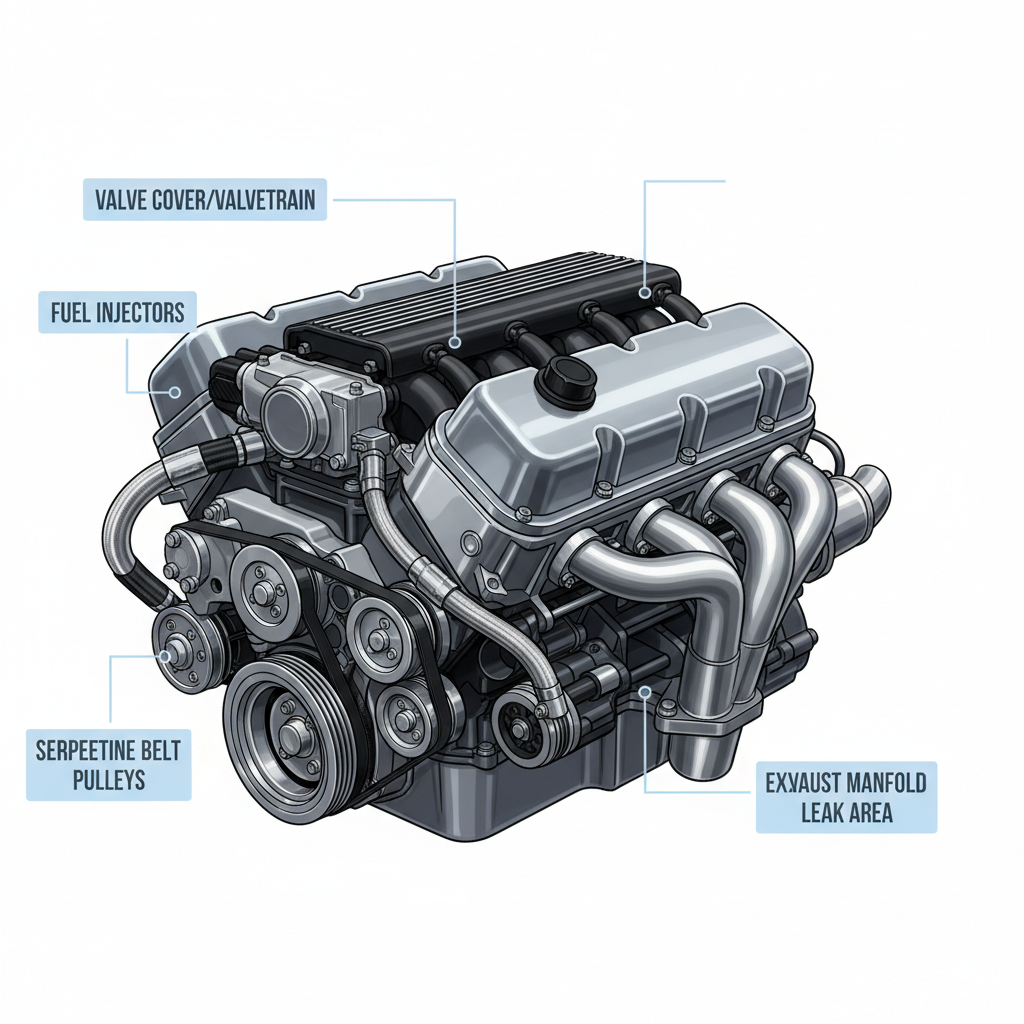
Oil level, oil condition, or wrong viscosity
Low oil, old oil, or oil that’s too thin/thick for the engine can make lifters noisy at idle. This is especially common if the tick shows up after an oil change, after a long interval, or when the engine is cold.
- Sound tends to come from the top of the engine.
- May improve as the engine warms up.
- May be worse after the car sits overnight.
According to AAA... routine maintenance like checking oil level and following the manufacturer’s service schedule helps reduce breakdown risk, and oil-related issues are a frequent preventable cause of trouble.
Hydraulic lifter noise / valvetrain wear
Hydraulic lifters rely on oil pressure to stay “pumped up.” At idle, pressure is lower, so a weak lifter or a varnished oil passage can tick more. Some engines are also just a bit ticky by design, especially if you compare a direct-injection engine to an older port-injection setup.
- Often a sharp tick at the valve cover.
- Can fade when RPM rises slightly.
- May come and go depending on temperature and oil.
Exhaust manifold leak (small “puff tick”)
A small leak near the exhaust manifold or a gasket can sound like ticking, especially on cold start. As metal expands, it may seal up a bit and quiet down.
- Often louder near the wheel well or manifold heat shield area.
- May smell like exhaust in the engine bay.
- Sometimes leaves faint soot marks near a flange.
Fuel injector ticking (often normal)
Many injectors make a rhythmic clicking that you can hear at idle with the hood open. Direct-injection systems can be noticeably loud and still be operating normally.
- Very consistent, metronome-like clicking.
- Sound seems strongest along the fuel rail/injector line.
- Usually no driveability symptoms.
Serpentine belt, pulley, or accessory noise
Sometimes the “tick” is actually a pulley bearing, belt tensioner, or accessory with a light tap/click. The sound can bounce around, so isolating it matters.
- Noise seems to come from the front of the engine.
- May change when A/C turns on/off.
- Can progress into squeal or growl if a bearing fails.
Self-check checklist: which bucket are you in?
If you want a fast path to how to fix car engine ticking noise at idle, classify your situation. This checklist isn’t a perfect diagnosis, but it points you toward the right first move.
- Tick started right after an oil change → verify oil level, correct viscosity/spec, correct filter, and no leaks.
- Tick loudest cold and fades warm → lifter bleed-down, oil viscosity, or small exhaust leak often fits.
- Tick stays hot or gradually worsens → valvetrain wear, oil pressure issue, or exhaust leak that’s growing.
- Tick comes with rough idle or misfire → don’t treat it as “just noise,” scan for codes and address misfire first.
- Tick only with A/C on → accessory load, pulley/tensioner, or compressor clutch area deserves attention.
Fixes you can try at home (in a sensible order)
Most people jump straight to additives. I’d rather you do the boring checks first, because they’re the ones that actually change the outcome.
1) Confirm oil level and obvious leaks
- Park on level ground, check the dipstick, and top off if low using the correct spec oil.
- Look for fresh oil around the drain plug, filter, valve cover, and under the car.
If the engine is low on oil and ticking, don’t keep idling it “to test.” Top off first, then reassess.
2) Verify the oil type matches the owner’s manual
- Check viscosity (like 0W-20, 5W-30) and the required standard (often API/ILSAC, sometimes manufacturer approvals).
- If the wrong viscosity went in, correcting it may reduce lifter noise at idle.
3) Listen for exhaust leaks and tighten what’s reasonable
- With the engine cold, inspect around the manifold and joints for soot traces.
- Lightly check heat shield fasteners; a loose shield can mimic a tick.
Exhaust manifold bolts can snap, and hot exhaust parts burn, so if access is tight or corrosion is heavy, it’s usually smarter to let a shop handle it.
4) Rule out accessory/pulley noise
- Turn A/C on and off and note any change.
- Visually inspect belt condition, and listen near the tensioner and idler pulleys.
According to NHTSA... you should address safety-related defects promptly, and while a tick isn’t automatically a safety defect, a failing accessory bearing can eventually lead to loss of charging or overheating, which can become a roadside safety issue.
5) Consider an oil change if you’re near due (or overdue)
If the oil is dirty or the interval ran long, fresh oil of the correct spec is a reasonable next step. In many cases, this is the cheapest “fix” that actually changes the noise, especially when varnish or thickened oil contributes.
6) Additives: when they’re worth trying, and when they’re not
Some detergents or lifter-focused additives may reduce ticking caused by deposits, but they’re not a substitute for mechanical repair. If you use one, follow the product instructions closely and stop if you notice new symptoms.
- More reasonable: mild lifter tick, no warning lights, oil pressure normal, maintenance history uncertain.
- Less reasonable: metal-on-metal noises, low oil pressure warning, heavy sludge, or any knock.
Practical table: cause, clues, and typical next step
| Likely cause | Clues at idle | What to do next |
|---|---|---|
| Low/incorrect oil | Top-end tick, worse cold, recent oil service or long interval | Check level, confirm viscosity/spec, change oil/filter if needed |
| Hydraulic lifter bleed-down | Tick fades when warm or with slight RPM increase | Confirm oil, consider cleaning approach, get valvetrain inspection if persistent |
| Exhaust manifold leak | Puffing tick, soot near joint, louder cold, exhaust smell | Inspect joints, repair gasket/fasteners, avoid DIY if bolts are seized |
| Injector clicking (normal) | Even, consistent click near injectors, no drivability issues | Compare to similar vehicle/engine, monitor, don’t “fix” what isn’t broken |
| Pulley/tensioner noise | Front-of-engine tick/click, changes with A/C load | Inspect belt drive, replace worn pulley/tensioner as needed |
Common mistakes that waste time (or make it worse)
- Ignoring the oil level because the car “runs fine”: a low oil situation can escalate fast.
- Throwing thicker oil at every tick: it may mask noise but can cause other issues, especially in engines designed for low-viscosity oil.
- Assuming all injector noise is a problem: some engines are naturally clicky at idle.
- Over-tightening exhaust fasteners: snapped bolts turn a small leak into a bigger job.
- Chasing sound without locating it: you can replace perfectly good parts and still have the same tick.

When it’s time to stop guessing and get a professional diagnosis
If you’re stuck, that’s normal. A ticking noise can travel through metal and make the source feel “everywhere.” A shop can use chassis ears, smoke testing (for exhaust leaks), and oil pressure testing to avoid guesswork.
- Oil pressure warning light or low-pressure reading.
- Tick gets louder quickly over days, not months.
- Misfire, rough idle, or power loss along with the sound.
- Metal in oil or glitter on the dipstick/oil filter media.
- Timing-related symptoms (rattle on startup, correlation codes) where the fix can be engine-specific.
According to ASE (National Institute for Automotive Service Excellence)... choosing trained, credentialed technicians can help ensure diagnosis and repairs follow recognized service standards, which matters when noises point to internal engine components.
Key takeaways (the short version)
- Start with oil level and correct oil spec; it’s the most common, least expensive win.
- Find the location before you buy parts, top-end tick and exhaust tick can sound surprisingly similar.
- Injector ticking can be normal, especially on direct-injection engines.
- If symptoms escalate or oil pressure is questionable, get a professional inspection.
FAQ
Why is my engine ticking at idle but not when driving?
At idle, oil pressure and engine speed are lower, so lifters and other top-end parts can be noisier. Some small exhaust leaks also “tick” more when cold and quiet down as you drive and parts expand.
Can low oil cause a ticking noise at idle?
Yes, it can. Low oil can reduce lubrication to the valvetrain and make a top-end tick more noticeable at idle. If you’re troubleshooting how to fix car engine ticking noise at idle, checking oil level is a sensible first step.
Is injector ticking at idle normal?
Often, yes. Many fuel injectors click rhythmically, and direct-injection systems can be louder than people expect. If the sound is even and you have no codes or drivability issues, it may be normal for that engine.
Will an oil additive stop lifter tick?
Sometimes it helps if deposits are part of the problem, but it won’t fix worn parts or low oil pressure. If you try an additive, treat it as a cautious experiment, not a guaranteed solution.
How do I tell the difference between exhaust tick and lifter tick?
Exhaust tick often sounds like a “puff” near the manifold area and may come with soot traces or exhaust smell. Lifter tick usually seems higher up at the valve cover and may change as the engine warms.
Can I drive with a ticking engine at idle?
It depends on the cause. If oil level is low, driving can be risky. If it’s normal injector noise, it may be fine. When you can’t confirm the source, especially with warning lights or worsening noise, it’s safer to limit driving and get it checked.
What should I ask a mechanic to check for an idle tick?
Ask them to confirm oil level/spec, verify oil pressure if needed, inspect for exhaust leaks near the manifold, and isolate accessory/pulley noise. That keeps the inspection focused and avoids random part swapping.
If you’re trying to fix an engine tick at idle and you want a more confidence-first path, consider scheduling a diagnostic visit where the shop can verify oil pressure, pinpoint the sound source, and give you repair options instead of guesses.