
how to diagnose car bad abs sensor symptoms usually comes down to separating a real wheel-speed sensor issue from lookalikes like low battery voltage, damaged tone rings, or wiring faults.
If you guess, you tend to replace the sensor because it’s “common,” then the ABS light stays on and you’re back where you started. A cleaner approach is to confirm symptoms, pull the right codes, then test the sensor circuit and signal in a simple order.
One more thing, ABS faults are safety-related. Your base brakes often still work, but ABS and traction/stability systems may be reduced. If the pedal feel changes a lot or the car feels unstable, it’s smart to drive cautiously and consider a professional inspection.
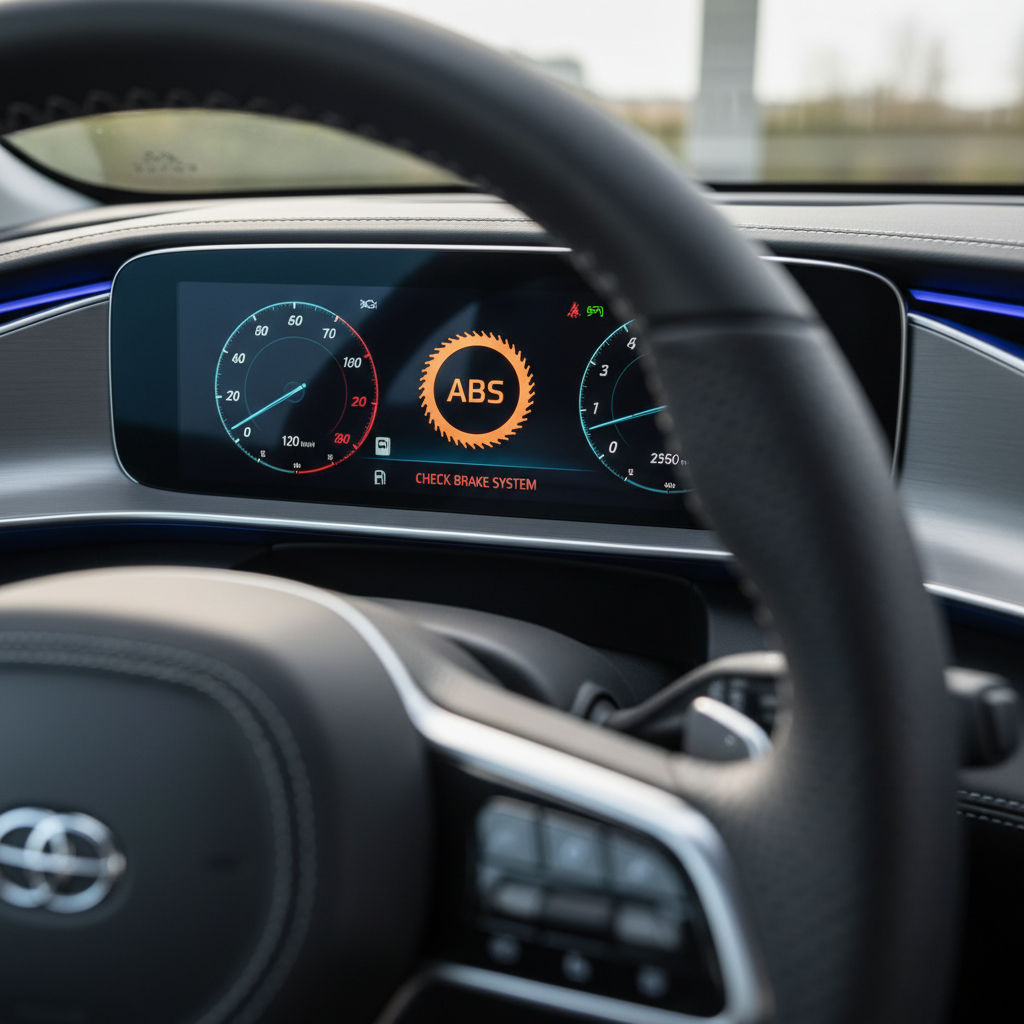
What a “bad ABS sensor” really means (and why it’s often not the sensor)
Most vehicles use wheel speed sensors to report each wheel’s rotation to the ABS module. When the module sees a signal that’s missing, implausible, or out of range, it logs a fault and may disable ABS, traction control, or stability control.
That said, “ABS sensor” gets blamed for several different failures:
- Sensor itself (internal open/short, weak signal)
- Wiring/connector (broken conductor near the knuckle, corrosion, water intrusion)
- Tone ring/reluctor (rust swelling, cracked ring, missing teeth, debris stuck to a magnetic encoder)
- Wheel bearing play changing the air gap so the sensor reads erratically
- Low system voltage causing modules to throw misleading ABS codes
According to NHTSA, ABS helps drivers maintain steering control during hard braking on slippery surfaces. So even if the car “stops fine,” the system matters most when traction is limited.
Common bad ABS sensor symptoms you can feel or see
Drivers usually notice a pattern, not just a single clue. Here are the symptoms that most often show up with a wheel speed input problem:
- ABS light on, sometimes with traction control or stability control lights
- ABS engages at low speed (a chattering pedal right before stopping, especially 5–10 mph)
- Speedometer odd behavior on some models that use wheel speed data for the cluster
- Traction control cuts in too early or won’t engage at all
- Intermittent warnings that come and go with rain, potholes, or temperature swings
What’s not typical for a wheel sensor by itself: a consistently spongy brake pedal, fluid loss, or grinding noises that only happen when braking. Those point you back to traditional brake/hydraulic issues.
Quick self-check checklist before you buy parts
If you’re trying to decide whether you’re looking at a bad sensor, wiring, or something else, this short checklist helps narrow it down.
- Does the ABS light come on right at startup? Often a stored fault or hard failure.
- Does it appear only after driving? More consistent with intermittent signal dropouts or bearing-related air gap changes.
- Any recent work? Tires, wheel bearings, CV axles, brakes, suspension work can tug wires or change sensor gap.
- Any obvious harness damage? Look for rubbing, stretched wires, or a loose connector near the wheel well.
- Battery/charging health okay? Weak battery voltage can trigger “implausible signal” faults.
If your car pulls hard, makes loud mechanical noise, or the brake pedal behavior feels unsafe, stop troubleshooting and get it checked. ABS diagnostics should never override basic safety.

Step-by-step: how to diagnose car bad ABS sensor symptoms
The most reliable path is: confirm the complaint, scan for ABS codes (not just engine codes), then validate the sensor’s power/ground/signal or its AC output depending on sensor type.
1) Read ABS codes with a scanner that supports ABS
A basic OBD-II reader may show nothing because ABS uses a separate module. Use a scan tool that can access ABS data.
- Record the code(s) and freeze-frame or event data if available.
- Note which wheel is flagged, but don’t assume the sensor is guilty yet.
- Check for low-voltage or communication codes that can cascade into wheel-speed complaints.
According to SAE International (OBD-related standards and diagnostic practices), diagnostic trouble codes are meant to guide testing, not replace it. In real shops, the code is the starting line.
2) Use live data to compare wheel speeds
On a safe, low-speed drive (or on a lift if you have proper equipment), watch live wheel speed readings:
- All four should track closely at steady speed.
- A sensor that drops to zero, spikes, or lags behind is a strong clue.
- If the issue happens only below ~10 mph, you might see one wheel “fall off” right before stopping.
This is one of the fastest ways to connect the warning light to a specific corner, and it supports how to diagnose car bad ABS sensor symptoms without blindly swapping parts.
3) Identify sensor type: passive (2-wire) vs active (often 3-wire)
Many older systems use a passive magnetic sensor (commonly 2-wire) that generates an AC signal. Many newer systems use an active Hall-effect or magnetoresistive sensor (often 3-wire) that needs a power supply and outputs a digital signal.
- 2-wire passive: you often test resistance and AC voltage output while spinning the wheel.
- 3-wire active: you verify power and ground, then check signal behavior (often best with a scope, sometimes with a meter depending on design).
4) Perform targeted electrical checks
These checks vary by vehicle, so use service information when possible. Keep your expectations realistic: some sensors won’t give meaningful resistance values.
- Connector inspection: bent pins, green corrosion, water, loose retention, damaged seals.
- Harness wiggle test: if live data drops out when you gently move the harness, wiring is suspect.
- Continuity/short checks between sensor and module (with the circuit isolated, and only if you know the right pins).
If you’re not comfortable back-probing connectors or interpreting diagrams, that’s a good point to pause. It’s easy to create a new problem with the wrong probing method.
5) Check the mechanical side: tone ring, bearing play, contamination
Plenty of “sensor” faults are mechanical:
- Tone ring damage: rust, cracks, missing teeth, or a ring that’s slipped out of place.
- Encoder contamination on magnetic rings: metal fuzz and debris can distort readings.
- Wheel bearing looseness: changes sensor air gap under load, causing intermittent dropouts.
If you see a cracked tone ring or can feel bearing play, replacing the sensor alone often disappoints.
Testing methods at a glance (table)
Use this table as a practical guide for matching symptoms to the next test, not as a final verdict.
| What you notice | Common causes | Best next check |
|---|---|---|
| ABS light on + code points to one wheel | Sensor, wiring, tone ring, bearing | Live wheel speed comparison + visual harness inspection |
| ABS activates at very low speed before stopping | Weak/erratic low-speed signal, rusty tone ring | Live data at low speed; inspect tone ring/encoder for rust/debris |
| Intermittent ABS/traction lights in rain | Water intrusion at connector, damaged insulation | Connector pin check for corrosion + wiggle test |
| Multiple wheel speed codes at once | Low voltage, module power/ground, network issue | Battery/charging check; scan for module voltage and comm codes |
| New wheel bearing/axle installed, then ABS light | Wrong bearing (encoder side), damaged sensor, incorrect gap | Verify correct part orientation; inspect encoder ring and sensor seating |

Practical fixes by scenario (what usually works)
Once you’ve confirmed which corner is misbehaving and why, fixes become straightforward. The trap is doing the right repair on the wrong diagnosis.
Scenario A: sensor signal drops out, wiring looks damaged
- Repair or replace the harness pigtail if available, especially near the steering knuckle where flexing is constant.
- Secure routing with proper clips so the wire won’t rub the tire or suspension.
- Clear codes, then retest live data on a short drive.
Scenario B: code returns immediately, connector shows corrosion
- Clean terminals only if they’re not heavily pitted; replace connector if pin fit is compromised.
- Use dielectric grease only where appropriate (typically seals), not as a “fix” for bad contact.
- Confirm the seal seats correctly to reduce repeat water intrusion.
Scenario C: low-speed false ABS activation with rusty tone ring
- Inspect tone ring teeth or magnetic encoder surface, remove debris if serviceable.
- If the ring is cracked or swollen with rust, replacement is usually the real fix.
- Recheck wheel bearing play, because excess movement can mimic a bad sensor.
Scenario D: you replaced the sensor but the problem stayed
- Re-check the harness end-to-end; new parts don’t fix broken copper.
- Verify the sensor fully seats and the mounting surface is clean.
- Confirm you’re reading ABS module codes, not only powertrain codes.
Common mistakes that waste time (and money)
- Scanning only the engine computer and assuming “no codes” means no ABS problem.
- Replacing the sensor from the code alone; wheel-specific codes can be triggered by tone rings or wiring.
- Ignoring battery voltage; weak charging can throw multiple module faults that look unrelated.
- Skipping live data; it’s often the quickest proof of a dropout.
- Overlooking recent repairs; plenty of ABS issues start right after suspension/brake work.
If you keep circling the same fault, pause and re-run the basics. In a lot of bays, the “hard” problem ends up being a rubbed wire behind a splash shield.
Key takeaways (quick recap)
- Codes point, tests prove: use ABS-capable scanning and live wheel speed data.
- Many bad ABS sensor symptoms come from wiring, tone rings, or bearings, not the sensor body.
- Low-speed chatter and intermittent lights often indicate signal quality problems.
- If braking feel changes dramatically, drive carefully and consider professional help.
When to get a professional diagnosis
If you don’t have an ABS-capable scan tool, or you suspect an active sensor signal issue that needs an oscilloscope, a shop can usually confirm it faster. The same goes for vehicles where the tone ring is integrated into the wheel bearing, because the “sensor code” may actually require bearing replacement.
Also consider professional support if you see multiple communication codes, or if the ABS module itself may have power/ground problems. Module diagnostics can get technical quickly, and the cost of a wrong module swap is high.
Conclusion
how to diagnose car bad abs sensor symptoms is less about one magic test and more about a calm sequence: verify warning lights and behavior, scan the ABS module, compare live wheel speeds, then inspect and test the specific corner for electrical and mechanical causes.
If you want a simple next step, start by getting an ABS-capable scan and live data read, then do a careful visual check of the harness and tone ring at the wheel the scanner flags. That combination solves a lot of “mystery” ABS lights without buying parts on a hunch.
FAQ
- Can I drive with a bad ABS sensor?
Often the vehicle still has normal braking, but ABS and stability features may be disabled. Drive cautiously, especially in rain or snow, and consider diagnosing it soon. - Will a bad ABS sensor cause the check engine light?
Many times it won’t, because the ABS module is separate from the engine computer. Some cars do share data, so you might see multiple lights, but you still need ABS module scanning. - Why does my ABS activate when I’m almost stopped?
This commonly happens when one wheel speed signal drops out at low speed, often from a rusty tone ring, debris on an encoder, or a weak sensor signal. Live wheel-speed data at low speed usually shows it. - How do I know which wheel speed sensor is bad?
An ABS code may name the wheel, but confirm with live data. If one wheel reads zero or spikes compared to the others, that corner deserves the close inspection. - Do I need a multimeter to diagnose a wheel speed sensor?
A multimeter helps for basic checks, but an ABS-capable scan tool with live data often gets you further. For some active sensors, a scope is the most reliable way to judge signal quality. - Is it common for wiring to fail near the wheel?
Yes, because the harness flexes with steering and suspension travel. Look for cracked insulation, stretched sections, or rub-through near brackets and liners. - After replacing the sensor, why is the ABS light still on?
Either the root cause isn’t the sensor (tone ring, bearing, wiring), the code hasn’t been cleared, or the vehicle needs a drive cycle to re-check. Re-scan the ABS module and compare live wheel speeds again.
If you’re trying to fix this efficiently, a scan tool that reads ABS codes and live wheel-speed data can save a lot of trial-and-error. If you’d rather not invest in tools, many local repair shops can confirm the failing corner quickly and tell you whether it’s a sensor, wiring, or a tone ring/bearing issue before you buy parts.