
How to diagnose car bad wheel speed sensor usually comes down to two things: spotting the right symptoms and confirming them with a few targeted checks instead of guessing and throwing parts at the car.
If your ABS light is on, traction control acts weird, or the speedometer occasionally drops out, a wheel speed sensor is a common suspect, but it’s not the only one. A damaged tone ring, rusty hub, frayed wiring, or even a weak wheel bearing can mimic “bad sensor” symptoms.
This guide walks you through a practical diagnosis flow that fits most U.S. vehicles, what to look for at the wheel, what a scan tool can tell you, and when it’s smarter to stop and get professional help.

What a wheel speed sensor does (and why failures feel “random”)
Each wheel speed sensor reports wheel rotation to the ABS module. That data feeds ABS, traction control, stability control, and on many cars even the speedometer and transmission shift logic.
Many “random” warning lights happen because the signal drops out only under certain conditions: turning, hitting bumps, heat soak after a drive, or when rust pushes the sensor slightly away from the tone ring. The car can feel normal, then suddenly throw an ABS light.
According to NHTSA, ABS helps drivers maintain steering control during hard braking on slippery surfaces. So even if the car still stops, ignoring ABS-related faults can reduce safety margins in emergency braking.
Common symptoms that point to a bad wheel speed sensor
Symptoms vary by vehicle, but these show up often enough that they’re worth taking seriously:
- ABS light on, sometimes along with traction control or stability control lights
- ABS activates at low speeds (a classic clue), you feel pedal pulsing when you’re almost stopped
- Traction control cuts power unexpectedly, especially in rain or during turns
- Speedometer dropouts on some models that use wheel speed for vehicle speed
- Stored ABS codes pointing to a specific wheel (left front, right rear, etc.)
One caution: a warning light alone does not confirm the sensor. It only tells you the system has detected an implausible signal somewhere in the circuit.
Quick self-check: are you dealing with sensor, wiring, or hub/tone ring?
Before you grab tools, use this short checklist to narrow the problem. It saves time and keeps the diagnosis honest.
- Only one wheel shows up repeatedly in codes or live data: often sensor, wiring, connector, or tone ring at that wheel
- Problem appears after rain or a car wash: commonly moisture in a connector or damaged insulation
- Problem appears during turns: wiring flex issue, loose connector, or wheel bearing play affecting the sensor gap
- Grinding/humming that changes with speed: wheel bearing wear can create false wheel-speed readings
- Recent brake/hub/axle work: sensor cable pinched, connector left loose, sensor not seated fully
Tools you’ll want (and what each one can actually prove)
You can diagnose a lot with basic tools, but the right tool makes the conclusion much clearer.
- OBD-II scanner with ABS capability: reads ABS codes and (best case) live wheel-speed data
- Digital multimeter: checks sensor power/ground (active sensors) and basic circuit continuity
- Jack, stands, lug wrench: safe wheel access
- Flashlight and small brush: for connector and tone ring inspection
If your scanner only reads engine codes (P-codes), you may miss the most useful info. Many affordable scan tools or Bluetooth dongles with the right app can read ABS modules, but compatibility varies by make.
Step-by-step: how to diagnose a bad wheel speed sensor
1) Pull ABS codes and freeze-frame style details
Read the ABS module, not just the engine ECU. Look for wheel-specific codes such as “right front wheel speed sensor circuit” or “signal implausible.” Write down the exact wheel and wording.
According to SAE, standardized diagnostic trouble codes are designed to guide systematic troubleshooting, not to automatically confirm a part failure. In practice, the code points you to a circuit or signal problem that still needs confirmation.
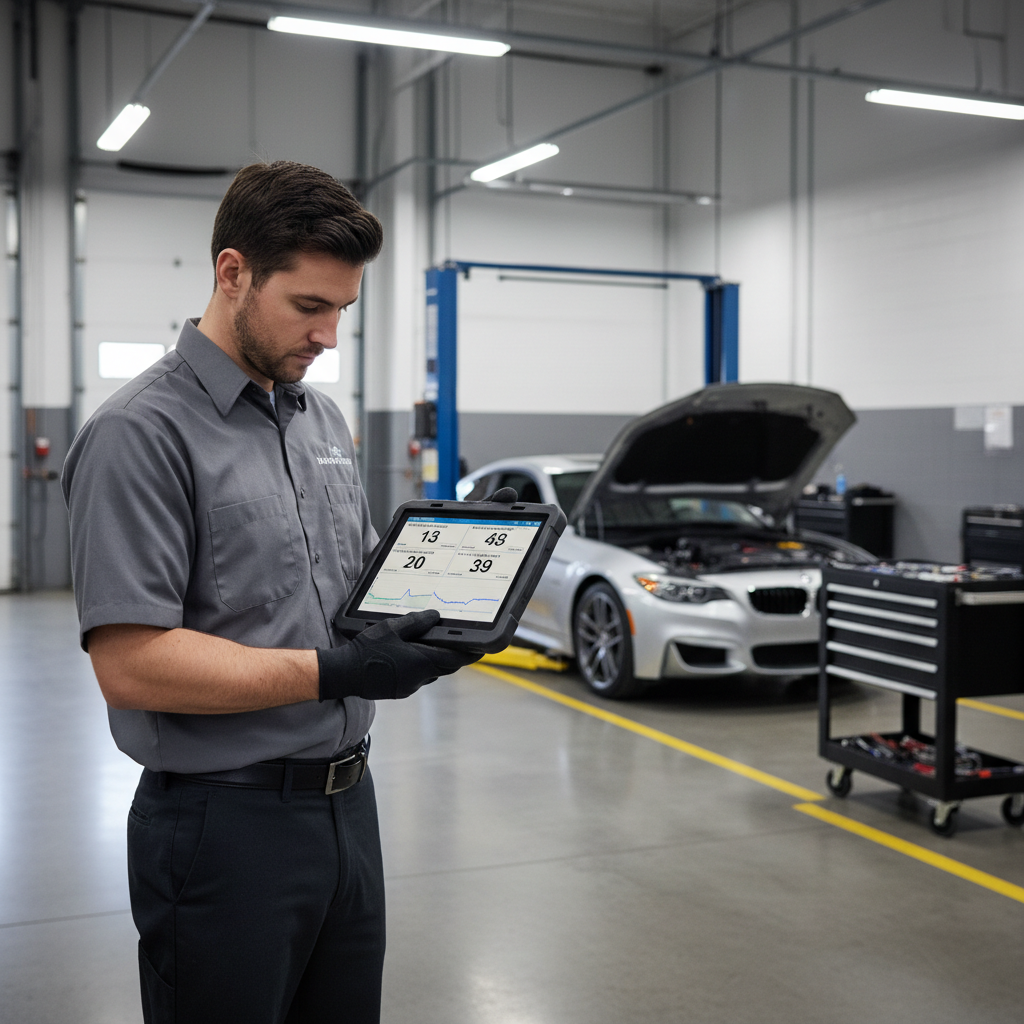
2) Check live wheel-speed data (the fastest confirmation)
With the vehicle safely lifted (or during a careful low-speed test in a safe area), compare all four wheel-speed readings.
- At the same speed, the four wheels should read very close.
- A sensor that drops to zero, spikes, or lags compared to the others is your likely fault location.
Key point: If the reading is wrong, the cause can still be the sensor, the wiring, the connector, or the tone ring. Live data tells you where to look, not what to buy.
3) Do a visual inspection at the suspected wheel
This is where many diagnoses become obvious.
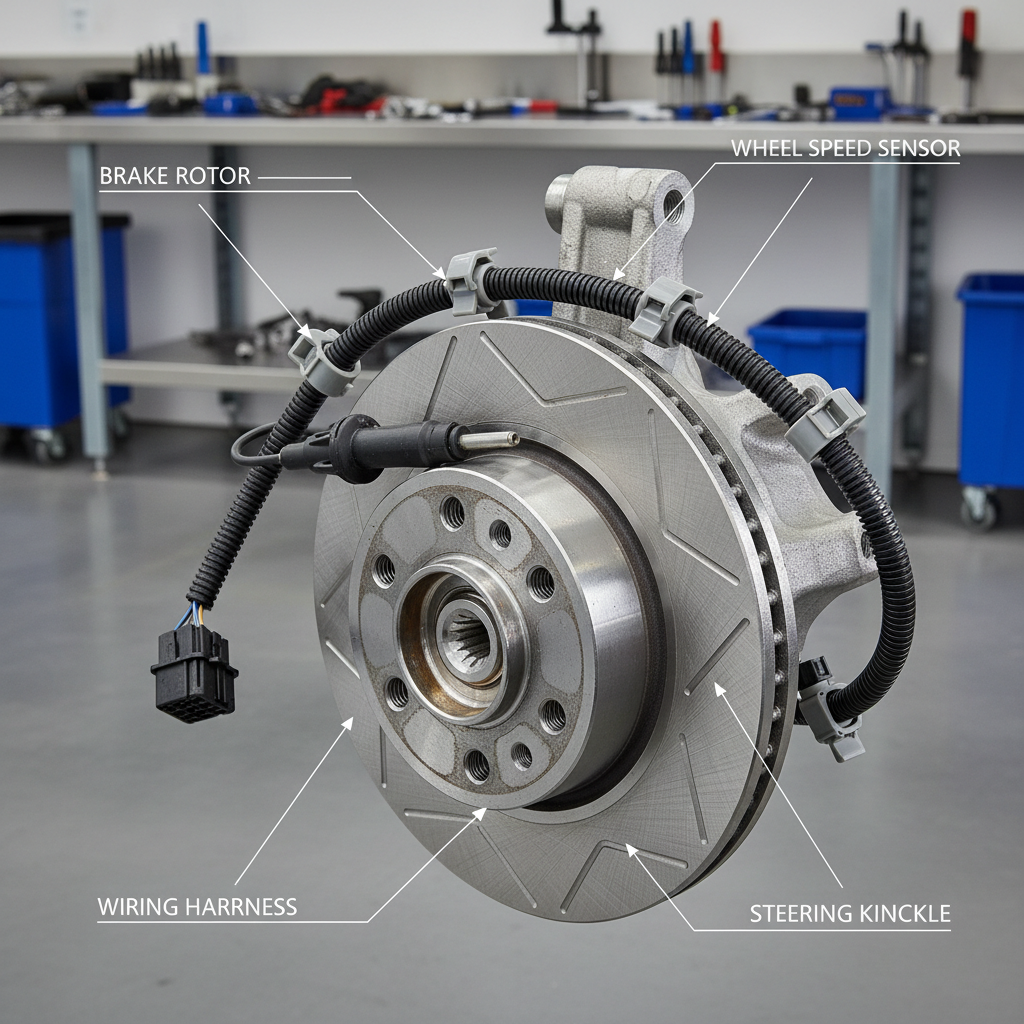
- Inspect the harness routing: look for rub-through near the strut, knuckle, or control arm.
- Unplug the connector: check for green corrosion, bent pins, water intrusion, loose lock tabs.
- Check sensor seating: if rust lifts the sensor, the air gap can go out of spec.
If you see a damaged wire jacket or corrosion inside the connector, fix that before replacing the sensor. A new sensor on a bad connector often buys you a repeat failure.
4) Inspect the tone ring / encoder (the “sensor looks fine” trap)
Depending on vehicle design, the wheel speed “target” might be a toothed ring on the axle, a magnetic encoder built into the hub bearing seal, or a tone ring integrated into the CV joint.
- Look for cracked teeth, heavy rust scale, missing sections, or debris stuck to a magnetic ring.
- If the wheel bearing has play, the sensor gap changes as the wheel loads, which can cause dropouts.
This is a common reason people replace a sensor twice and still have the same ABS light.
5) Use a multimeter wisely (and know its limits)
Wheel speed sensors come in two broad types: passive (variable reluctance) and active (Hall-effect/magnetoresistive). Testing differs by design, so service info for your car matters.
- Active sensors often need a supply voltage and ground; you can check for power/ground at the connector and for shorts to ground.
- Passive sensors may show a resistance value, but resistance alone doesn’t prove the sensor works under load.
If you’re not sure which type you have, don’t guess with back-probing. In many cases the safest move is to rely more on scan tool data plus visual inspection.
Diagnosis table: symptom → most likely causes → what to check next
Use this as a reality check when the signals feel confusing.
| What you notice | Common causes | Next check |
|---|---|---|
| ABS light + code for one wheel | Sensor signal dropout, wiring damage, corroded connector | Live data comparison, harness/connector inspection |
| ABS activates at very low speed | Weak sensor signal, rust-lifted sensor, damaged tone ring | Inspect sensor seating and tone ring/encoder |
| Problem mainly after rain/wash | Water intrusion in connector, insulation nick | Unplug, inspect pins, dry and protect connector |
| Wheel speed reading spikes while driving straight | Intermittent wiring open, failing sensor electronics | Wiggle test harness while watching live data (safely) |
| No wheel-speed data on any wheel | ABS module power/ground, blown fuse, scan tool limitation | Check fuses, module power feeds, tool capability |
Practical fixes by scenario (without overbuying parts)
Once you’ve narrowed the fault, pick the fix that matches what you found.
If the connector is dirty or corroded
- Clean gently with appropriate electrical contact cleaner.
- Make sure pins are tight and not pushed back.
- Route the harness so it doesn’t pull during steering travel.
If the wiring is chafed or broken
- Repair with automotive-grade methods: sealed splices, heat shrink, proper strain relief.
- Avoid twisting wires together and taping; it often fails with vibration and water.
If rust or debris affects sensor seating
- Remove the sensor carefully, clean the mounting surface so it sits flush.
- Reinstall and confirm live wheel speed reads stable at low speed.
If the tone ring/encoder is damaged or the bearing is noisy
- Plan for a hub/bearing or axle repair depending on design.
- If there’s bearing play, solving only the sensor issue tends to be temporary.
Common mistakes that waste time (and how to avoid them)
- Replacing the sensor because a code says “sensor”: many codes describe the circuit/signal, not the part.
- Ignoring the other three wheel speeds: comparison is your friend, especially with intermittent faults.
- Skipping the tone ring check: cracks, rust, or magnetic encoder damage can look subtle.
- Testing the wrong module: engine codes won’t tell you much about ABS.
- Unsafe lifting: if you’re spinning wheels off the ground, use stands and keep hands clear.
When to stop DIY and get a pro involved
If braking feels unstable, warning lights multiply, or live data shows multiple wheels behaving oddly, it may be more than a single sensor. A shop with OEM-level scan tools can run automated ABS tests, verify module power/ground integrity, and check network communication.
Also consider professional help if you suspect a hub bearing or axle tone ring issue and you don’t have the tools for press work or torque-to-spec reassembly. Brakes and wheel-end work has real safety stakes, so if you’re unsure, it’s reasonable to consult a qualified technician.
Key takeaways you can use today
- Confirm the bad corner with ABS codes and live wheel-speed data before buying parts.
- Inspect wiring and connectors closely; many “sensor failures” are actually harness issues.
- Don’t skip the tone ring/encoder, especially if ABS triggers at low speed.
- Fix the root cause: rust-lifted sensors and worn bearings create repeat problems.
Conclusion: a reliable diagnosis beats a fast guess
How to diagnose car bad wheel speed sensor is less about one magic test and more about a clean sequence: read ABS codes, compare live wheel speeds, inspect the wheel-end hardware, then decide whether you need wiring repair, a sensor, or a hub/encoder fix. If you take that route, you’re far less likely to chase the same ABS light twice.
If you want one simple next step, start by pulling ABS codes and identifying whether the issue stays on one wheel, then do a connector and harness inspection at that corner before ordering parts.
FAQ
- Can I drive with a bad wheel speed sensor?
Often the car still drives, but ABS and stability functions may be limited. If you notice abnormal braking behavior, it’s safer to reduce driving and have it checked. - Will a bad wheel speed sensor cause the speedometer to stop working?
On some vehicles, yes. Others use a transmission output sensor or a different signal source, so it depends on the platform. - Why does the ABS activate when I’m almost stopped?
This commonly happens when one wheel reports a lower speed than the others at low speed, which can come from a weak sensor signal, corrosion changing the sensor gap, or tone ring damage. - Do I need an alignment after replacing a wheel speed sensor?
Usually no, because the sensor itself doesn’t change suspension geometry. If you replaced a hub, knuckle, or control arm during the repair, an alignment becomes more likely. - How do I know which wheel speed sensor is bad without a scan tool?
You can sometimes find obvious wiring damage or a broken tone ring by inspection, but without ABS live data you’re often guessing. Borrowing a scanner with ABS support is typically worth it. - Can a wheel bearing cause wheel speed sensor codes?
Yes, especially if the bearing has play or the magnetic encoder is integrated into the bearing seal. The sensor may be fine, but the target surface is not. - After replacing the sensor, the ABS light is still on—now what?
Clear codes, verify the new sensor shows stable wheel-speed data, then re-check the connector seating and the tone ring/encoder. If the code returns immediately, wiring or module issues become more likely.
If you’re diagnosing an intermittent ABS light and want a more straightforward path, using an ABS-capable scan tool (or having a shop pull live wheel-speed data) can save money compared with swapping sensors one by one, especially when the real problem is wiring or the hub encoder.