
how to check car engine oil change interval is mostly about finding what your specific model calls for, then adjusting for how you actually drive, not what a generic sticker says.
A lot of drivers in the U.S. still hear “every 3,000 miles,” but that advice came from older engines, older oils, and rougher fuel standards. Many modern cars can go longer, while some real-world use cases still justify shorter intervals.
This guide shows a practical way to confirm your interval by model year and engine, cross-check it against oil type and your oil-life monitor, then decide what interval makes sense for your situation. You’ll also see the common traps that lead to over-changing or, worse, running oil too long.

Start with the model-specific sources (not the windshield sticker)
If you want the most accurate interval for your exact vehicle, start with sources tied to your VIN, engine, and model year, because “same nameplate” can still mean different engines and intervals.
- Owner’s manual (maintenance schedule): usually lists normal vs severe service intervals, plus the required oil viscosity and specs.
- In-car maintenance minder / oil-life monitor: many newer vehicles calculate oil life based on temperature, trips, load, and time.
- Manufacturer website or app: some brands provide VIN-based maintenance plans.
- Dealer service advisor: useful when your manual is vague, but still confirm they’re using the correct engine and oil spec.
According to the U.S. Department of Energy (FuelEconomy.gov), following the manufacturer’s recommended maintenance schedule supports efficiency and helps avoid unnecessary service. That’s a good baseline mindset: let the model guidance lead, then adjust for your conditions.
What “by model” really means: engine, oil spec, and model year
People search how to check car engine oil change interval and assume the trim badge answers it, but the interval often changes with the powertrain and oil requirements.
Three details to confirm before you trust any interval
- Engine code / displacement: a 2.0T and a 3.6 V6 in the same model line may not share intervals.
- Oil spec and viscosity: “0W-20” isn’t the full story; many cars require specs like dexos, VW 504/507, MB 229.5, etc.
- Model year: manufacturers revise intervals when engines, PCV systems, turbo setups, or oil monitoring logic changes.
If you’re pulling info from a forum post or a quick Google snippet, match the exact year and engine before you apply it. That tiny detail is where people get burned.
Use this quick table to set a realistic starting interval
You can treat the manual or oil-life monitor as “the rule,” and this table as “the sanity check.” It helps you see when your interval might be on the long side or when short intervals may be justified.
| Vehicle setup / use case | Common starting point | Why it shifts the interval |
|---|---|---|
| Modern engine + full synthetic + mostly highway | Often 7,500–10,000 miles (or monitor-based) | Steady temps and fewer cold starts reduce contamination |
| Mixed driving + synthetic blend | Often 5,000–7,500 miles | More heat cycling and idling than highway-only |
| Turbo engine, short trips, frequent stop-and-go | Often 3,000–5,000 miles or shorter monitor intervals | Higher heat and fuel dilution can degrade oil faster |
| Severe service: towing, mountain driving, extreme heat/cold | Use “severe” schedule in manual | Higher load and temperature stress oil and additives |
| Low mileage but time passes (rarely driven) | Often 6–12 months | Moisture and acids build even without many miles |
Don’t treat these numbers as universal. Use them to question outliers, like a shop recommending 3,000 miles for a newer car on full synthetic with an oil-life monitor that still reads 60%.

Self-check: are you “normal” or “severe” service in real life?
Many manuals define severe service in a way that surprises people. If you match even a few items, your interval usually should be shorter than the “normal” line in the schedule.
- Most trips are under 5–10 miles, especially in cold weather
- Long idling or slow traffic is routine
- Frequent towing, roof box use, or heavy cargo
- Hot climate, dusty roads, or lots of short hills
- Turbocharged engine with spirited driving habits
- Oil level drops between changes, even if no leaks show
Key point: severe service is about operating conditions, not whether you drive carefully. Plenty of gentle city driving still counts as severe because the engine rarely reaches stable operating temperature.
Step-by-step: how to check your oil change interval by model (and verify it)
If you want a repeatable process that works for almost any vehicle, follow this sequence. It’s the easiest way to answer how to check car engine oil change interval without relying on guesses.
1) Pull the interval from the owner’s manual
- Look for “Maintenance Schedule” or “Normal/Severe Service.”
- Write down the mileage and time limit, whichever comes first.
- Note the required viscosity and any oil specification language.
2) Check whether your car uses an oil-life monitor
- Find where it displays oil life percentage and how it’s reset.
- If the manual says “follow the oil-life system,” do that, but keep an eye on time-based limits.
3) Confirm your oil type matches the interval assumption
- If the schedule assumes synthetic and you use conventional, your safe interval may be shorter.
- If your engine requires a specific certification (dexos, etc.), use it, because the additive package matters.
4) Adjust for your driving pattern
- If you check multiple “severe” boxes, use the severe schedule or let the monitor lead.
- If you drive mostly highway, the longer end of the recommended range often makes sense.
5) Track it once, then stop thinking about it
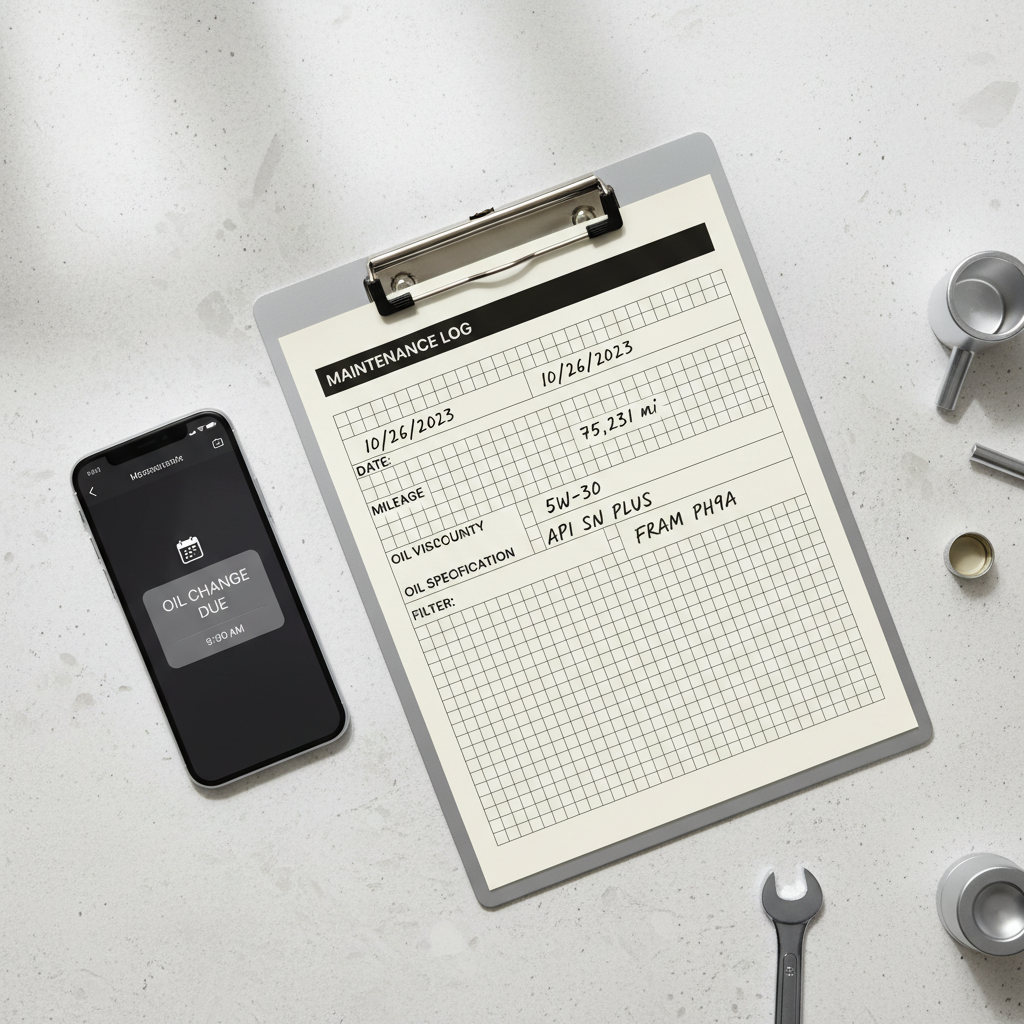
- Log mileage, date, oil brand/viscosity/spec, and filter part number.
- Reset the monitor correctly, or your next reminder becomes meaningless.
Practical tips that make intervals easier to live with
Where people stumble is consistency. You don’t need a perfect number, you need a routine that protects the engine and fits your schedule.
- Pick an interval you’ll actually follow: if you always forget at 7,500, choosing 6,000 is better than running 11,000 by accident.
- Use “whichever comes first”: mileage and time both matter, especially for low-mile drivers.
- Check oil level monthly: some modern engines consume oil normally, and low oil can cause damage long before “change interval” is reached.
- Match the filter to the interval: longer intervals generally call for a quality filter designed to last that span.
According to SAE International, oil-life monitoring systems estimate remaining oil life based on operating conditions rather than a fixed mileage alone. In plain terms, the car is watching how hard the oil works, not just how far you went.
Common mistakes that lead to wasted money or engine wear
Some mistakes are expensive, some are just annoying, and a few quietly shorten engine life over time.
- Assuming “full synthetic” means you can always go 10,000 miles: many cars can, some shouldn’t, and severe service changes the math.
- Ignoring time limits: oil can degrade from moisture and contamination even with low miles.
- Not resetting the oil-life monitor: the system becomes unreliable, then you’re back to guessing.
- Using the wrong oil spec: the viscosity might match, but the required certification may not, which can affect protection and deposits.
- Chasing “dark oil” as a change trigger: oil often darkens quickly because it holds contaminants, that’s not automatically a problem.
If you suspect sludge, coolant contamination, or abnormal consumption, don’t stretch intervals “to see what happens.” That’s where small issues turn into big repairs.
When it’s worth getting professional help (or an oil analysis)
Most drivers can set an interval with the manual and monitor. The edge cases are where a shop’s judgment or lab testing can save you money.
- New-to-you used car: if maintenance history is unclear, a baseline oil change and inspection is smart, then you can set a schedule.
- High-mileage engine or oil burning: a technician can check for leaks, PCV issues, or other causes; recommendations vary by engine design.
- Heavy towing / commercial use: oil analysis may help dial in intervals based on wear metals and fuel dilution, especially for fleets.
- Warning lights, milky oil, fuel smell: stop driving if severe, and consult a qualified mechanic, because those signs can indicate mechanical problems beyond routine maintenance.
According to AAA, routine vehicle maintenance helps reduce breakdown risk and can improve reliability. If your driving is demanding or the car has a known issue pattern, a quick professional check can be a good trade.
Key takeaways you can use today
- Use your manual and oil spec as the “truth,” then let your real driving decide whether you follow normal or severe intervals.
- Oil-life monitors are helpful, but only if you reset them correctly and still respect time-based limits.
- Short-trip city driving often counts as severe, even when miles stay low.
- Track one cycle with date and mileage, then set a reminder so you stop re-Googling it.
Conclusion: a simple way to stop guessing your oil change interval
If you’ve been bouncing between a shop sticker, internet advice, and what your dashboard says, bring it back to basics: confirm the interval by model year and engine in the manual, verify oil spec and monitor behavior, then choose the normal or severe schedule that matches your daily driving.
Your next move can be simple: check your owner’s manual tonight, write down the mileage and time limit, then set a phone reminder that hits “whichever comes first.” That one habit usually does more than debating 5,000 vs 7,500 ever will.
FAQ
- How do I find my exact oil change interval if I bought my car used?
Start with the owner’s manual for your model year, then confirm the engine and oil spec on the oil cap or in the manual. If records are missing, many people do an immediate oil change and begin tracking from that mileage. - Is the oil-life monitor more accurate than a fixed mileage interval?
Often, yes, because it reflects operating conditions like short trips and temperature swings. Still, you should follow any time limit in the manual, and make sure the monitor is reset correctly after service. - Does full synthetic always mean I can go 10,000 miles?
Not always. Some manufacturers allow it, but turbo engines, short-trip use, towing, or certain oil specs may call for shorter intervals even with synthetic. - What if my shop sticker says 3,000 miles but my manual says longer?
Use the manual as your baseline, then apply the severe-service criteria honestly. Many shops default to conservative intervals; that may be fine, but it’s not automatically model-correct. - How often should I change oil if I only drive a few thousand miles per year?
Many schedules include a time-based interval, often 6–12 months, because oil can accumulate moisture and acids over time. Check your manual for the exact limit for your model. - Can I rely on oil color to decide when to change it?
Oil darkening is common and doesn’t automatically mean it’s “worn out.” If you want a data-based approach, an oil analysis can be helpful, especially for long intervals or heavy-duty use. - What’s the biggest red flag that I shouldn’t wait for my next scheduled change?
A low oil level, oil pressure warning, milky appearance, or strong fuel smell can signal a problem. In those cases, it’s safer to stop and consult a qualified mechanic.
If you’re still unsure which schedule fits your driving, or you want a more “set it and forget it” plan, a quick call with a trusted local shop or dealership service advisor can help you match your model’s oil spec and interval without overpaying for unnecessary changes.